

In 2025, omnichannel has become the baseline for retail. Customers don’t think in terms of “online” or “offline” anymore – they expect one seamless journey.
Digital channels continue to expand but physical stores remain a vital part of the mix. Far from being replaced, they are evolving into experience centres and fulfilment hubs. Research shows that opening a physical store doesn’t just drive footfall but it also boosts local online sales by up to 20% [Reuters].
This article is a joint collaboration between us and our client partner, Sage Appliances, written together to share our perspectives on the evolving role of omnichannel retail.
Sage Appliances (known as Breville in some international markets) is a premium kitchen appliance brand, recognised for combining design and innovation, and known for their unified commerce approach.
Why Stores Still Matter
Across Europe, shoppers continue to value physical stores. A recent UK survey found that 61% of consumers still prefer in-store purchases over online [Retail Economics]. Stores offer something that digital alone can’t fully deliver – the chance to see, touch and try products as well as get advice from real experts.
Working with brands like Sage demonstrates the true power of an omnichannel retail experience, connecting physical and digital touchpoints to drive great results.
Today’s customers explore every corner of the retail landscape before making a purchase, so brands need to ensure their journey is cohesive and compelling at every step. Our in-store teams bring brands to life through immersive, personal experiences. While our digital teams reinforce and extend that engagement. Together, these channels create a unified customer journey that inspires confidence for our customers and clients.
— Annemarie Smith, Stellar Account Director for Sage Appliances
On top of having products and experts in department stores, many brands are now opening experience hubs. Brand stores that showcase products, offer hands-on demonstrations and provide a personalised service that strengthens customer loyalty. Both of these create a “halo effect,” where physical locations not only generate their own sales but also amplify online performance.
Blending Physical and Digital
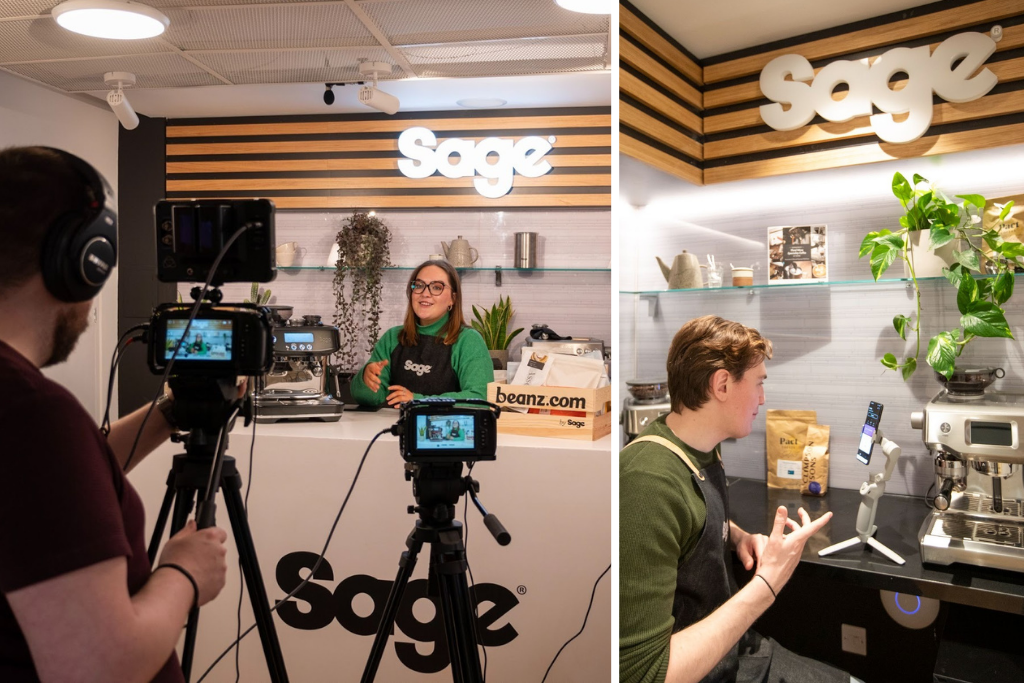
Sage Appliances is demonstrating how powerful this mix can be.
In department stores like John Lewis and Harrods, Sage brings its products to life through immersive displays and brand experts who guide shoppers in real time. These experiences drive confidence, discovery and conversion.
At the same time, Sage extends this expertise into digital channels. On both their own website as well as John Lewis’, customers can connect instantly with real product specialists via chat or video – the online equivalent of approaching an advisor in-store. On social platforms like TikTok Shop, Sage meets customers in the moment by inspiring, entertaining and engaging audiences – shortening the path from discovery to purchase.
Supporting customers across every touchpoint has never been more critical. Journeys now run from social media and social selling to email, deal-led comms, referrals and, crucially, the shop floor.
Demographics and signals may differ but one constant remains: people want help from humans. They want to understand how a product will meet their needs, fulfil their wants and create an emotional connection. Working with Stellar has given us a scalable, human-first model. Live demonstrations with their experts in store, reinforced by their specialists via video chat online, customers get one connected Sage experience wherever they start. Less noise, more confidence, better outcomes.
— Ashlea Morgan, BRG UK Sales Manager
The result is a unified journey. Whether a customer discovers Sage on TikTok, browses at Harrods, or chats online with an expert, the brand experience feels consistent and connected.
The Future Is Seamless
For retail leaders and brands, the message is simple. Omnichannel isn’t about choosing between digital or physical, it’s about making every channel work together.
In fact, 73% of shoppers now use multiple touchpoints before making a purchase [UniformMarket] and the most successful brands are those who integrate them into one ecosystem.
That means investing in physical environments that inspire, digital platforms that engage and data systems that connect the dots. It also means putting people at the heart of the experience – whether that’s in-store experts, live video consultations or personalised support.
From a market perspective, premium SDA is a high-consideration purchase. So when we put trained experts on the shop floor and mirror that expertise online, we consistently see the operational levers that matter: higher conversion vs self-serve fixtures, larger baskets through meaningful attachments, lower returns thanks to correct set-up and expectation-setting, and stronger advocacy post-purchase.
Physical locations also create a halo effect, which lifts local search, click-and-collect and D2C traffic, so it’s not store or digital, it’s store and digital working.
Our SiS execution is built around that reality: clear storytelling, comparative demonstrations, and live milk texturing to help customers trade into the right solution, not just the nearest promotion. This is why Stellar’s model gives us national reach without losing door-level nuance.
We can then measure what matters: demo-to-sale, assisted revenue share, appointment conversion, post-purchase NPS and attachment rate, not just revenue.
This is how we turn omnichannel from a buzz word into a repeatable, profitable growth engine.
— Ashlea Morgan, BRG UK Sales Manager
At Stellar and Sage, we know the future of retail is not only frictionless but also human-first. Physical stores remain important to that vision, building trust and driving discovery – while digital channels extend that reach through connection and convenience.
Together, they form the retail model that will win 2025 and beyond.